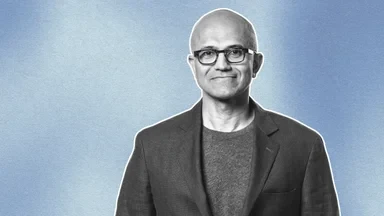
Right now, the most consequential emerging idea in artificial intelligence might not originate from a peer-reviewed research paper, a high-profile model launch, or a cutting-edge performance benchmark. Instead, it could come from a short opinion essay published by Microsoft CEO Satya Nadella.
In the piece, Nadella argues that the long-term success of modern organizations hinges on what he terms the dynamic interaction between human capital and token capital: on one side, people’s inherent knowledge, critical judgment, professional relationships, and creative ingenuity, and on the other, the AI capabilities that companies build and own for internal use.
The terminology he introduces is new, but the core observation underpinning it is not. Over the past several months, I have published a series of articles laying out a closely related argument. This series opened with the claim that large language models were never designed to run full operations for businesses, continued with the case that enterprise AI must shift its focus from delivering generic answers to driving tangible business outcomes, and eventually concluded that enterprise AI is still waiting for its own equivalent of the World Wide Web. Through all of this work, my core point has stayed consistent: the central challenge holding back scalable, useful enterprise AI is not the raw intelligence of models themselves—it is the underlying system architecture.
What makes Nadella’s essay so compelling is that it reaches many of these same conclusions from an entirely different starting perspective. If you follow his line of reasoning closely, it leads directly to a conclusion that much of the enterprise AI industry still seems reluctant to confront: the future of enterprise AI does not center on the model. It centers on the continuous learning loop.
The most revealing sentence in Nadella’s essay may be this one:
Satya Nadella is Asking the Right AI Question