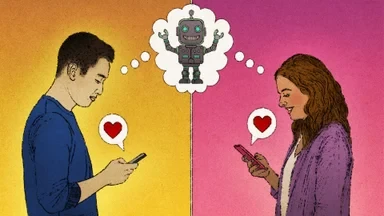
AI Takes a Seat at the Dating Table: How Technology Is Reshaping Modern Romance
When 36-year-old Marie Lansley moved to a new city for a fresh job and began searching for a romantic partner, she tried every strategy under the sun to find a match—including turning to artificial intelligence for support. For Lansley and thousands of other singles across the United States, AI chatbots have become on-demand, de facto dating coaches and relationship experts.
Lansley regularly consults chatbots to craft opening lines for dating app matches, a task she says feels surprisingly tricky online, even though she has no trouble striking up conversations in person. While she stays optimistic about what AI can bring to her search, she recognizes the inherent disconnect between the organic art of romance and the rigid precision of technology.
“I’m open to AI helping me find the love of my life, but I’m also not fully convinced it actually can,” Lansley said. “AI is great at making dating more efficient. But the chemistry—that’s always going to be a human thing.”
Singles who integrate AI into their dating lives use the technology in a wide variety of ways. Some sign up for AI-powered matchmaking services, while others lean on AI tools to refine and polish their dating profiles. The most widespread use, though, is enlisting chatbots to draft messages to potential matches and help interpret confusing messages they receive.
Lansley alternates between OpenAI’s ChatGPT and Anthropic’s Claude, while other singles turn to options like xAI’s Grok, Google’s Gemini, and a host of other emerging chatbot tools. Major AI developers and dating apps are leaning hard into this growing trend: both ChatGPT and Gemini have posted TikTok content showcasing their chatbots’ ability to deliver customized, personality-filled relationship advice.
“Claude is the new Cyrano,” dating coach Carey Gaynes said, referencing the 19th-century French play Cyrano de Bergerac, where the title character writes romantic dialogue for another man to woo his love interest. “You’re using a voice that isn’t yours.”
Gaynes, who hosts the YouTube dating channel Coffee with Carey, says she has seen daters of all ages turn to AI, both among her clients and her online following. She acknowledges the tool can be helpful for daters who struggle with conversation starters, but like many observers, she worries about the risks of overreliance on technology for such a personal process.
Opinions on AI’s role in romance are deeply nuanced, spanning everything from eager excitement to stubborn resistance and cautious skepticism. Lansley says she has been caught off guard by how much emotional intelligence chatbots can appear to display. During an onboarding call with an AI matchmaker on the dating app Known, she says the bot’s questions went “one or two levels deeper” than the generic prompts traditional dating apps use, and it seemed to actively strive for empathy. That deeper insight did not guarantee a better match, though: her first AI-generated pairing was far from a perfect fit.
Mason Naung, a 25-year-old student in Los Angeles, doesn’t use chatbots to get message ideas himself, but he can see their value for crafting icebreakers during the early back-and-forth with a new match. “I’ve been on Hinge on and off for a year or two, and sometimes I kind of struggle to think about what the opening line should be with someone I like, right?” he said. But if AI was writing messages beyond those initial greetings, that would register as a “small red flag” for him.
Just as chatbots can help start new connections, they can also help end connections more gently. Dani Cohen, a 27-year-old business owner in San Diego, says she would much rather receive an AI-written farewell message from someone she’s dated a few times than be “ghosted,” or cut off without any explanation at all.
“Obviously, in a perfect world, everyone knows exactly what they want to say and how to say it in the kindest way possible, and they follow through,” she said. “That’s not the world we live in. Anything that gets people to communicate, and communicate their thoughts kindly and effectively, is great.”
Many of the people who spoke with The Associated Press—including those who already use AI for dating help—expressed reservations about letting technology interfere with such deeply personal parts of life. Most AI-using daters draw a clear line between appropriate and inappropriate uses that they refuse to cross, while others would never consider turning to a chatbot for help with their love life at all.
Clara Sullivan, a 22-year-old student in Los Angeles, says she would not reply to a potential partner if she learned they were sending her AI-written messages. “I think it’s really scary how reliant people are on it,” Sullivan said. “It’s completely gotten rid of people’s ability to think creatively and on their own.”
That sentiment is widely shared. A 2025 survey from the Pew Research Center found 53% of U.S. adults believe AI will weaken people’s ability to think creatively, while half of respondents said they expect AI to erode people’s ability to form meaningful romantic relationships.
Even with widespread public hesitation, the merging of AI and the multi-billion-dollar dating industry was largely inevitable. Dating apps have been integrating AI into their platforms for years: Tinder offers an AI-powered feature called Chemistry that suggests profiles tailored to a user’s unique interests, while Hinge uses AI to generate conversation starters and provide profile feedback to help make interactions smoother. The founder of dating app Bumble recently announced the platform will soon phase out its iconic swipe feature and shift to AI-driven matchmaking. After facing public backlash over the decision, Bumble CEO and founder Whitney Wolfe Herd shared a statement noting that the company’s new approach “is rooted in a simple belief: Technology should make love and connection feel more human, not less.”
Mohammed Nizami, 23, uses AI for many areas of his life, but draws the line at dating. “We’re all craving some degree of authentic connection. Certainly with your partner, you want that,” he said. “If there’s some filter or barrier between you and your partner or potential partner, I think that’s just not a great way to start a relationship.” Nizami added that chatbots do not always offer the best guidance: the overly agreeable, sycophantic nature of many chatbots may be “good for your own mental comfort” but does not always lead to sound relationship advice.
Despite widespread hesitation, AI is expected to play an increasingly large role in modern dating moving forward. “It’s kind of a sad commentary on the state of the world. Dating is supposed to be one of the things that cannot be replaced, right?” said Jake Clay, a 30-year-old content creator in New York City. “It’s kind of sad to think that something so pivotal to your life journey is being outsourced to an AI who can’t understand the emotions around it.”
Clay notes that he now receives far fewer requests from friends to help decode confusing messages from potential matches, since those friends now turn to chatbots instead. He wryly appreciates AI “lifting the load” in that area, but still argues that AI in dating “is circumventing some of the normal processes in life that I feel like should be a little bit more sacred.”
AI Takes a Seat at the Dating Table: How Technology Is Reshaping Modern Romance