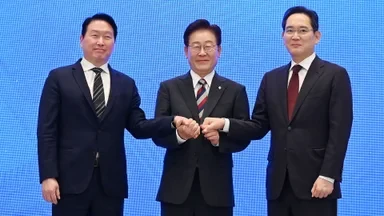
South Korea’s leading technology giants Samsung Electronics and SK Hynix announced Monday that they will pour a combined 800 trillion won ($518 billion) into developing a new semiconductor manufacturing hub in the country’s southwestern region, tapping into booming AI-fueled demand for advanced chips.
South Korean President Lee Jae Myung joined the two firms’ board chairs for the launch event, and the initiative aligns with the government’s goal to spread major investment beyond the greater Seoul metropolitan area — the country’s economic center and the current core of its global semiconductor industry. The southwest has been a top priority for this decentralization push: it lacks large established industrial hubs, has historically trailed other regions in economic growth, and has long served as a political base for President Lee’s liberal Democratic Party.
Together, Samsung and SK Hynix control roughly two-thirds of the global memory chip market. Under the new plan, each company will build two new fabrication plants (fabs) in the southwest, expanding beyond their existing manufacturing complexes in Gyeonggi Province, which lies south of Seoul. Samsung Chairman Lee Jae-yong confirmed that the firm’s new fabs will be located in the southwestern city of Gwangju, where experts have shortlisted several potential sites, including the grounds of a military air base scheduled for relocation. The companies have not yet announced a firm completion date for the new southwestern facilities.
SK Hynix Chairman Chey Tae-won noted the project is a complex, large-scale undertaking that requires “vast plots of land, plus consistent access to power, water, and a skilled workforce.” He pointed out that it took SK Hynix nine years to build its current major manufacturing cluster in Gyeonggi Province, but added that massive capacity expansion is necessary to keep up with growing global chip demand.
Government officials have addressed concerns over whether the southwest has enough power and water infrastructure to support large semiconductor fabs, noting the region’s strong renewable energy sector will actually give chipmakers a competitive edge. This is particularly valuable as the global industry faces growing pressure to shift to cleaner power sources.
Both Samsung and SK Hynix have posted record profits in recent months, as soaring global investment in data centers and other AI infrastructure has driven up demand for memory chips. Government officials and industry analysts expect AI-driven chip demand to keep climbing as the technology spreads to new use cases like AI-enabled industrial robots and autonomous vehicles. They also project the companies’ existing Gyeonggi Province complexes will hit full capacity much sooner than originally expected.
During Monday’s event, officials outlined a broader plan to build a nationwide interconnected semiconductor ecosystem: existing production hubs in the southeast will scale up output of chip components and materials, the central Chungcheong region will specialize in advanced chip packaging, and new data centers will be built across the country.
“We must build out the core infrastructure for artificial intelligence faster than any other country. Semiconductors, physical AI and AI data centers are the three pillars of our next great leap forward,” President Lee said.
—Kim Tong-Hyung, Associated Press
Join us in New York City this September for the annual Fast Company Innovation Festival. Discounted advance tickets are available for purchase now through Sunday, July 12. Reserve your festival passes today.
Samsung and SK Hynix Announce $518 Billion Investment in AI-Driven Chipmaking Hub