It’s a well-documented pitfall of science fiction cinema: many works overhype near-future technological breakthroughs, only to end up looking laughably outdated once the “future” of their story becomes our lived present. Not all sci-fi falls into this trap, however.
When Steven Spielberg created his 2001 opus A.I.: Artificial Intelligence, he avoided this misstep entirely by setting the story in the comfortably distant 22nd century—far enough out that he would never live to see his technological predictions proven wrong. As the film marks its 25th anniversary this Monday, it remains entirely unsurprising that we have not yet developed technology capable of building a robot that can pass seamlessly for actor Haley Joel Osment, for example.
Unfortunately for modern humanity, one of the film’s core tech prophecies did not need a full century to come to fruition. It is already here, and it has already proven far more profoundly harmful than even Spielberg might have imagined back in 2001.
A.I. Artificial Intelligence (2001) Theatrical Teaser Trailer • 5.1 • 4K • FTD-1459 - YouTube
A.I. follows the story of David (Osment), a prototype “mecha” robot built to resemble a young human boy and programmed to exude the unconditional love of a child. David was designed specifically to provide comfort to grieving parents who have lost a child, and couples who cannot conceive children of their own.
If the premise already sounds ethically fraught—creating a robot child permanently bonded to a parental figure who may one day decide they no longer need that companion—rest assured the film unpacks this conundrum exhaustively. In doing so, it also explores the meaning of love, the essence of humanity, and the wide range of roles artificial intelligence may one day occupy in human society.
Though the film earned mostly positive critical attention upon release, mainstream audiences greeted it with notable coolness. Despite being positioned as a tentpole summer blockbuster, A.I. grossed just $78 million at the domestic box office and made barely any lasting cultural impact at the time. Only in the years since has the project, which was first conceived decades earlier by Stanley Kubrick, grown in reputation to become widely recognized as a major cinematic achievement.
Many aspects of the future depicted in A.I. remain far beyond our current reach, while others already feel alarmingly close. The film’s infamous Flesh Fair—an event where unemployed humans destroy the robots that replaced them in the workforce—feels like a natural extreme extension of today’s fierce grassroots opposition to data centers and AI-driven automation.
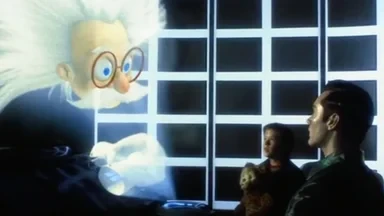
But the prophecy that has already fully come true relates to how humans access and process information with the help of artificial intelligence, and this narrative beat unfolds entirely in one pivotal scene.
25 Years Ago, This Scene From Steven Spielberg’s A.I. Predicted the Collapse of Objective Reality